
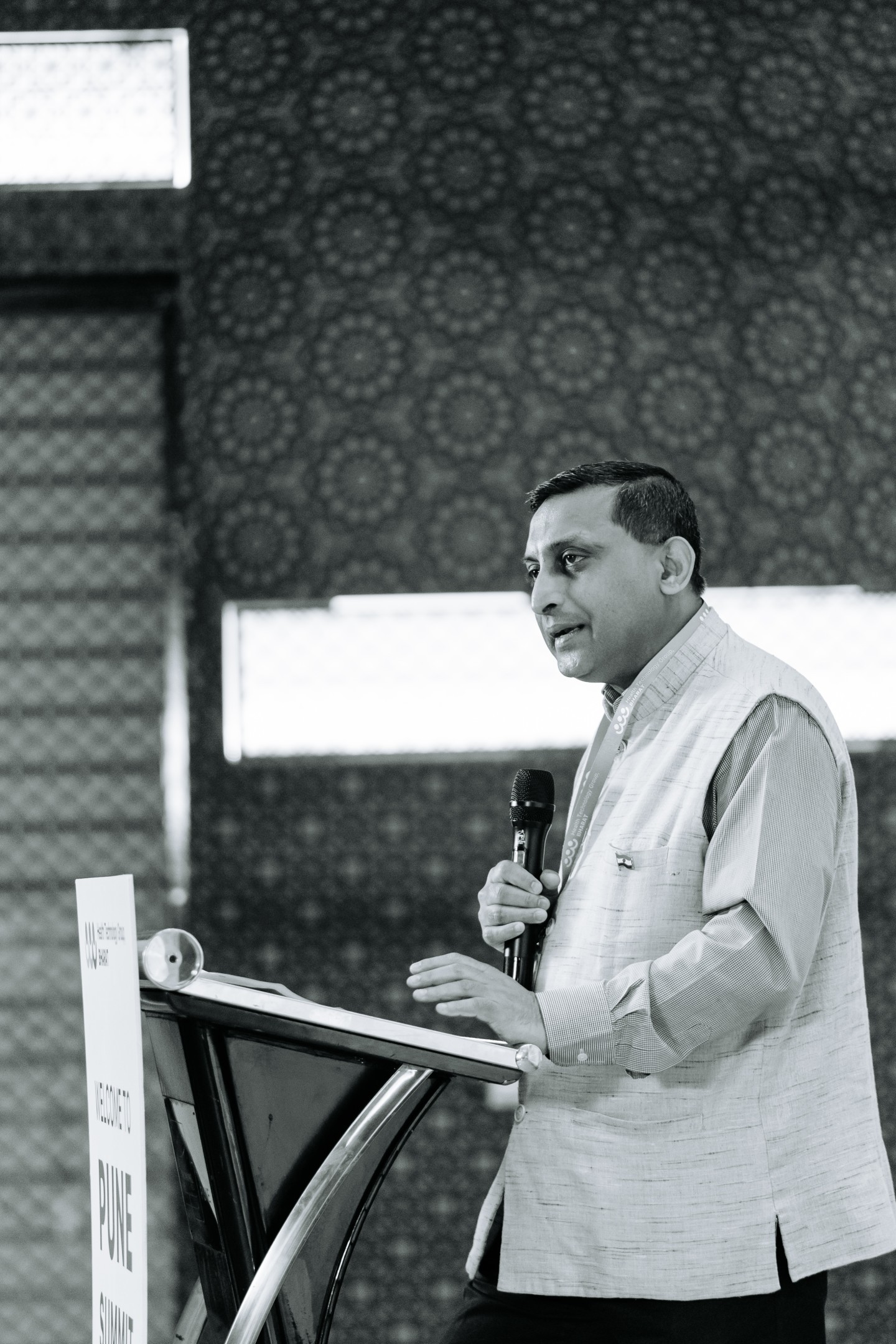
Health Technology Group (HTG) Bharat Annual Summit in Pune was held on 25 April 2026. I was asked to deliver the welcome address and set the tone for the summit by sharing my inputs on Building Pune’s innovation ecosystem for medtech.
=======
Good morning everyone,
Health has always been an evergreen space—full of opportunity for inventors, technology translators, product builders, entrepreneurs, and investors. It offers not just the chance to build meaningful solutions, but also to create real social impact alongside strong financial outcomes.
But what makes this moment truly special is that we are not operating in ordinary times anymore.
In recent years, we’ve seen a dazzling array of enabling technologies emerge—technologies that are fundamentally changing what is possible in healthcare.
For the first time, we can solve problems that were previously unsolvable.
We can dramatically improve solutions to problems that were poorly addressed.
And perhaps most importantly, we can finally understand problems that we didn’t fully grasp before.
So what are these technologies driving this transformation?
On the digital side, we have exponential advances in computing power and speed. We have miniaturization, making devices smaller, cheaper, and more accessible. The internet and mobile phones have connected billions of people. We now have powerful sensors, massive data storage capabilities, and cloud computing infrastructure.
And layered on top of all this is the rise of generative AI and blockchain.
But it doesn’t stop there.
There are several other equally important technological breakthroughs—printed electronics, advanced battery technologies, solar innovations, gene editing techniques like base and prime editing, synthetic biology, tissue engineering, cell therapies, and mRNA technologies.
Together, these are not just incremental improvements. They are foundational shifts.
And that is why I strongly believe—this is an extraordinary time to build a health technology startup.
========
Now, let me bring this closer to home.
At Venture Center in Pune, we started building an innovation ecosystem for knowledge-intensive, science-based, IP-rich startups nearly 20 years ago. While we are sector-agnostic, we made a conscious decision to make health and medtech one of our core pillars.
Today, we have worked with more than 1,100 startup teams. Of these, about 300 to 400 have been resident on our campus, and nearly half operate in health and medtech.
Most of these are manufacturing and B2B startups.
Our mentees span across more than 23 states—but our heart remains in Pune.
=========
Over these two decades, we’ve learned several important lessons about building in medtech.
First, medtech innovation requires a rich, diverse, and deeply interconnected ecosystem. It’s not enough to have just good ideas or strong founders.
You need access to clinicians and hospitals. You need industry experts. You need data and biological samples. You need a deep understanding of regulations, and the ability to navigate pre-clinical and clinical validation.
You need academic networks, hospital partnerships, and funding at multiple stages.
And importantly, many of these capabilities take years—sometimes decades—to build.
Second, the ambitions of innovators are often limited by the quality of the ecosystem around them.
When the ecosystem is shallow, founders think small.
When the ecosystem is deep and unique, founders are empowered to take bold bets early.
Third, building an ecosystem is not the job of a single institution.
It requires collective effort. It requires people who are willing to be generous—who look beyond immediate gains and focus on long-term value.
Sometimes the key contributors are networking “nodes.”
Sometimes they are shared infrastructure providers.
Sometimes they are mentors.
And sometimes, they are patient investors.
Fourth, ecosystems need continuity.
If startups are to grow within a city and contribute back to it, the ecosystem must support them at every stage. If there are gaps—especially in critical areas—startups will simply move elsewhere.
And we are already seeing that happen.
Finally, ecosystems reach a tipping point.
Beyond a certain scale and scope, they become self-sustaining. They grow autonomously. They attract talent, capital, and opportunity at an accelerating pace.
==========
Now, let’s talk specifically about Pune.
For health and medtech startups, we are relatively fortunate.
We have a fairly diverse innovation ecosystem, with good institutional depth and spread. Of course, it would be wonderful to have institutions like an IIT or AIIMS here—but even without them, we have strong foundations.
In terms of quality, our ecosystem is competitive within India. However, when compared to global hubs, we still lag in areas like access to large-scale financing and well-organized datasets and sample repositories.
One area where Pune truly shines is in the generosity of its ecosystem builders.
There are many individuals and organizations contributing selflessly. Platforms, networks, and programs are being built with genuine intent. There is a strong culture here that values scholarship, patience, and creative effort.
However, continuity remains a concern.
Access to financing is still a serious challenge. Proximity to large markets is another. As a result, we are losing startups—some to Bangalore, and some to global innovation hubs.
In terms of scale, Pune is likely among the top ecosystems in India, possibly second only to Bangalore. But we have not yet reached global critical mass.
So the question is—what should we do next?
==========
What is the call to action?
First, we must build unique, high-quality shared assets for the ecosystem.
This could include centers of excellence for medical disciplines, centers for enabling technologies, and institutions that can aggregate and provide access to data and biological samples.
Second, we should actively advocate for the establishment of institutions like IITs and AIIMS in Pune.
Third, we must attract global capability centers of leading medtech companies to the city.
Fourth, we need to nurture the “nodes” of the ecosystem—the connectors, the mentors, the platforms. Supporting these nodes is one of the highest-leverage investments we can make, because a strong ecosystem delivers impact year after year.
I would encourage everyone here to participate—as innovators, as mentors, as collaborators, and as well-wishers.
Fifth, we must build a large pipeline of medtech startups—so that a meaningful number of them become investment-ready. This, in turn, will attract investors from across the country and the world.
Pune is also home to significant family wealth and strong business communities—this is an opportunity to bring them into the innovation journey.
Sixth, we must build Pune as a receptive market for new ideas and products—both from private and public sector buyers.
And finally, we need high-quality platforms for networking—platforms that bring together all stakeholders, while also educating and inspiring the next generation of innovators.
The good news is that some of these actions are within immediate reach—especially building shared assets, nurturing ecosystem nodes, and strengthening platforms.
==========
And that brings me to this very event.
The HTG Summit is exactly the kind of platform that Pune should be proud of—and actively nurture.
Because ecosystems are not built overnight.
They are built through consistent effort, shared vision, and collective participation.
And if we get this right, Pune has the potential not just to participate in the global health innovation movement—but to lead it.
Thank you.